Canopy

Digital Community Tree for Mindfulness

Digital Community Tree for Mindfulness

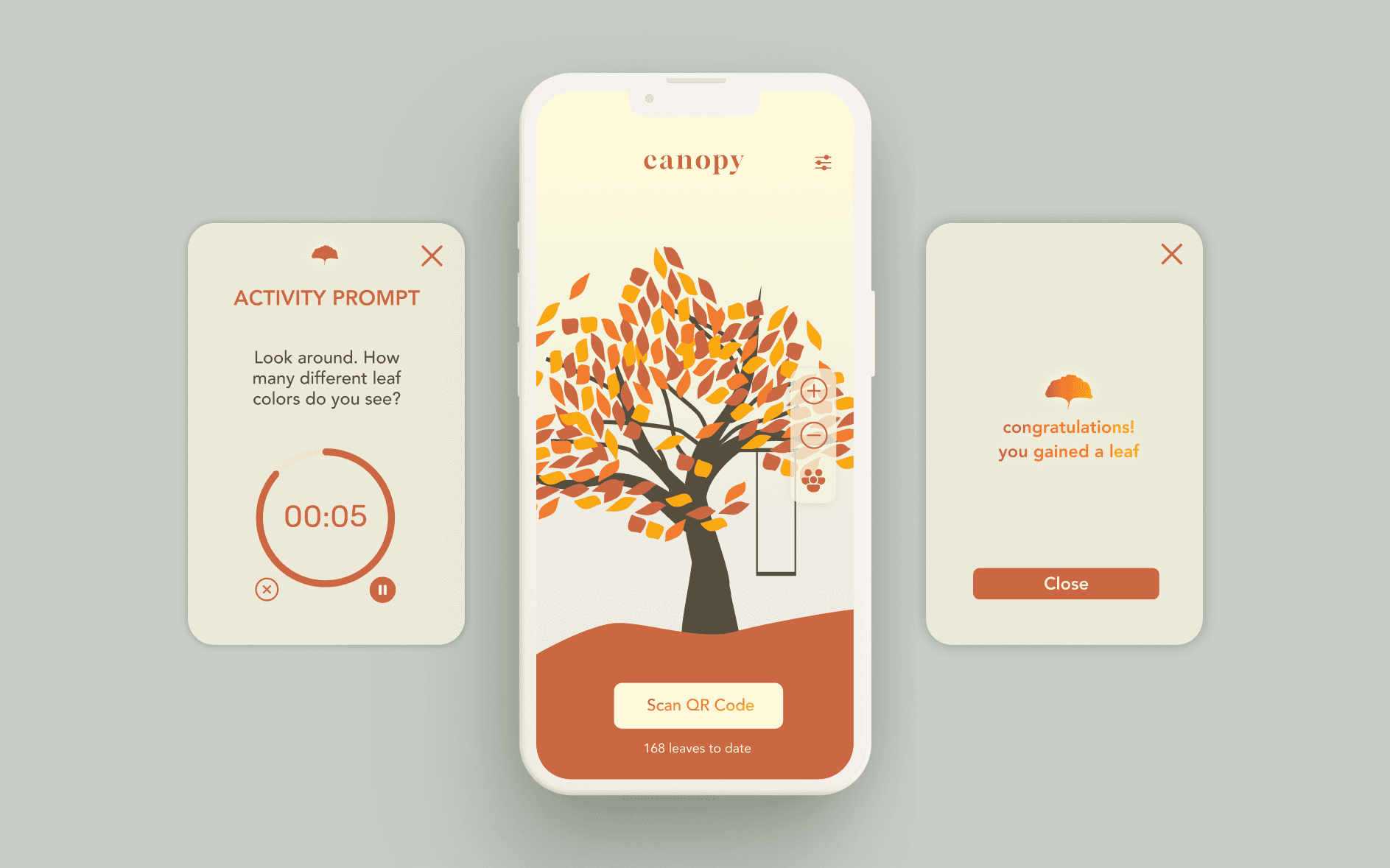
The Canopy app offers a unique mindfulness experience that encourages users to interact with nature. The app’s activity prompts are accessed through QR codes around the WashU arboretum which lead to short, engaging mindfulness activities. With each participant's interaction, the community digital tree grows.

Context

Context

Group Project (Interaction Design: Understanding Health and Wellbeing)

Group Project (Interaction Design: Understanding Health and Wellbeing)

Timeline

Timeline

November 2024 to December 2024

November 2024 to December 2024

Team

Team

Three peer student designers

Three peer student designers

Skills

Skills

User interviews, Card sorting

User interviews, Card sorting

Background

How could Mindfulness Week better support students to learn about and experience mindfulness and to take insights into their study, work, or lives?

How could Mindfulness Week better support students to learn about and experience mindfulness and to take insights into their study, work, or lives?

For this project, my team partnered with the Mindfulness Science and Practice group, hosts of Mindfulness Week at WashU. While mindfulness practices have been shown to significantly improve student mental health, turnout remains low at Mindfulness Week. 

For this project, my team partnered with the Mindfulness Science and Practice group, hosts of Mindfulness Week at WashU. While mindfulness practices have been shown to significantly improve student mental health, turnout remains low at Mindfulness Week. 

Defining the Problem

As a whole, we interviewed 6 people: 3 Mindfulness Week attendees and 3 non-attendees. From these interviews, we compiled 80 datapoints and drew the following 3 insights:

Synthesis and Brainstorming

With this idea in mind, we began by outlining a high-level storyboard of our vision for Canopy, our digital community tree. At its core, we wanted Canopy to motivate students to participate in brief mindfulness activities by contributing to a growing tree.

My team wanted to create a product that would serve both our community partners at the Mindfulness Group and our product’s potential users—WashU students.

My team wanted to create a product that would serve both our community partners at the Mindfulness Group and our product’s potential users—WashU students.

I took a three-pronged approach to research:


  1. Attending Mindfulness Week events myself to observe and experience their programming.

  2. Understanding current literature on mindfulness and meditation interventions in schools.

  3. Conducting interviews with students, faculty, and community members encompassing a wide range of mindfulness knowledge and experience.

I took a three-pronged approach to research:


  1. Attending Mindfulness Week events myself to observe and experience their programming.

  2. Understanding current literature on mindfulness and meditation interventions in schools.

  3. Conducting interviews with students, faculty, and community members encompassing a wide range of mindfulness knowledge and experience.

As a whole, we interviewed 6 people: 3 Mindfulness Week attendees and 3 non-attendees. From these interviews, we compiled 80 datapoints and drew the following 3 insights:

Synthesis and Brainstorming

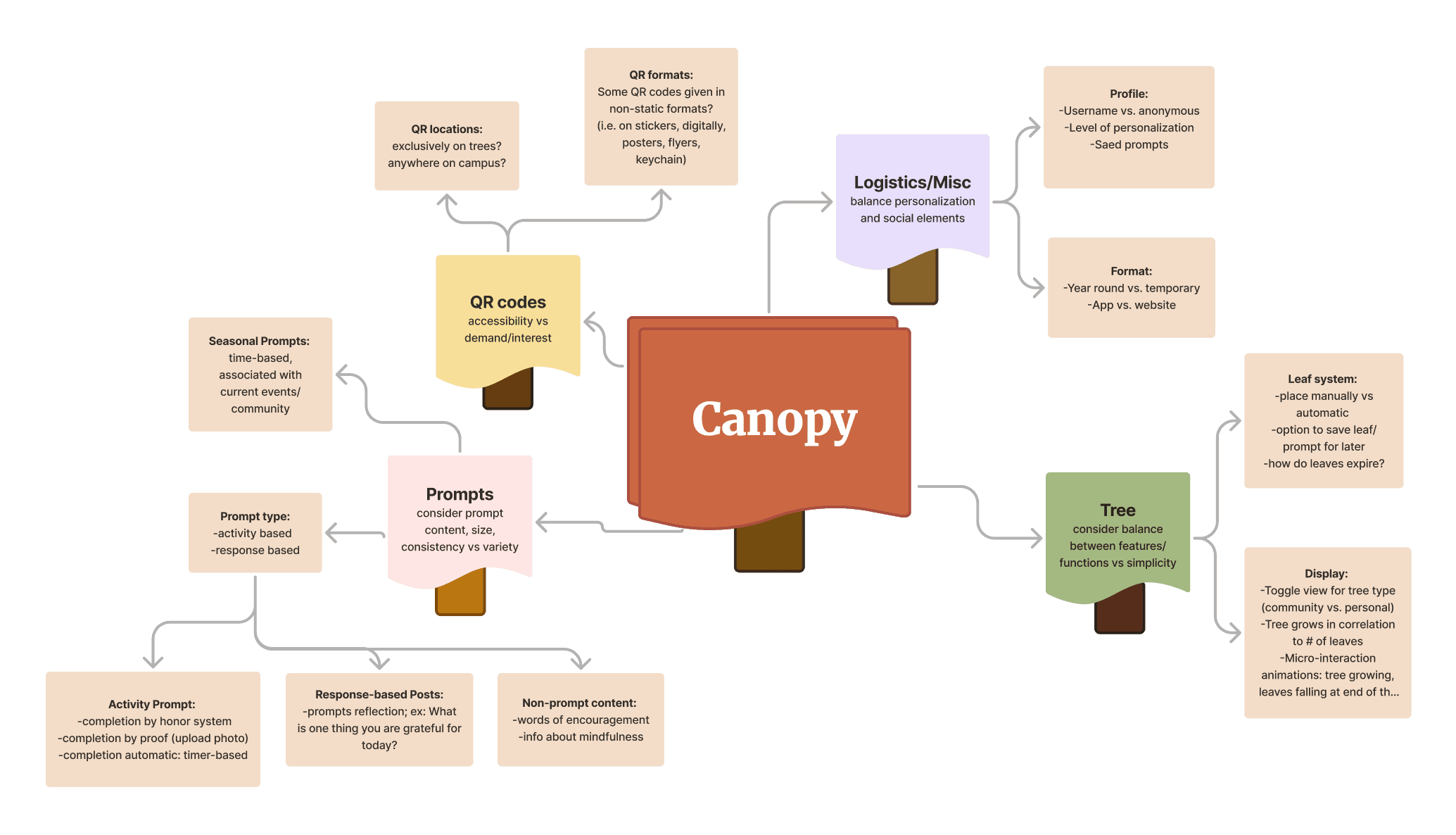
I led a question-storming workshop with my team to align on the details of Canopy. Everyone on the team shared their questions and we ran a theme sort to look for patterns. During this discussion, we covered everything from the logistics of the app’s integration with Mindfulness Week to the type of prompts encountered within the app.

I realized that there were an incredibly vast number of questions to consider, so we had to prioritize certain aspects while leaving others less fully developed. 

Going from broad research to concrete ideas meant dreaming big and far (and wacky).

Going from broad research to concrete ideas meant dreaming big and far (and wacky).

From these insights we held a group brainstorming session and accumulated 30+ concept ideas. Aligning on feasibility, accessibility, distinction, and desirability, we decided to take the idea of a “group mindfulness tree” into further development and prototyping. 
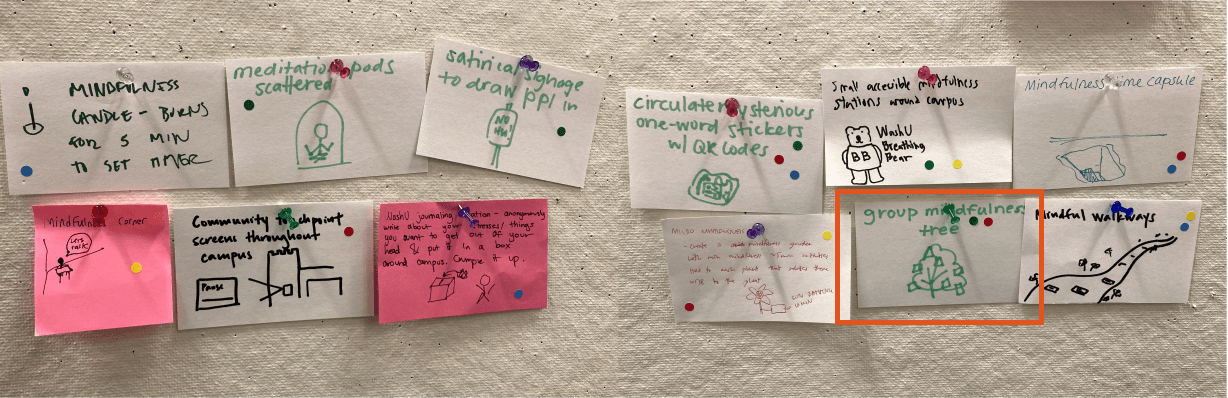
From these insights we held a group brainstorming session and accumulated 30+ concept ideas. Aligning on feasibility, accessibility, distinction, and desirability, we decided to take the idea of a “group mindfulness tree” into further development and prototyping. 

With this idea in mind, we began by outlining a high-level storyboard of our vision for Canopy, our digital community tree. At its core, we wanted Canopy to motivate students to participate in brief mindfulness activities by contributing to a growing tree.

I led a question-storming workshop with my team to align on the details of Canopy. Everyone on the team shared their questions and we ran a theme sort to look for patterns. During this discussion, we covered everything from the logistics of the app’s integration with Mindfulness Week to the type of prompts encountered within the app.

I realized that there were an incredibly vast number of questions to consider, so we had to prioritize certain aspects while leaving others less fully developed. 
User Research

Concept testing before drilling into design helped gain a bird's eye view of our goals.

Concept testing before drilling into design helped gain a bird's eye view of our goals.

"People don't need points."

To test our initial lo-fi concept, we talked to 8 potential users, 3 clients from the Mindfulness Group, and 3 guest designers. I wrote interview guides for each of these user groups.

To test our initial lo-fi concept, we talked to 8 potential users, 3 clients from the Mindfulness Group, and 3 guest designers. I wrote interview guides for each of these user groups.

Concept testing goals:


  1. What motivates students to participate in mindfulness activities. Is the tree enough, or do there need to be layered incentives?

  2. Opportunities for integration with Mindfulness Week, and opportunities to extend Canopy’s reach beyond one week.

  3. How to design the user flow—from QR scanning to prompt completion—to be seamless and worthwhile.

Concept testing goals:


  1. What motivates students to participate in mindfulness activities. Is the tree enough, or do there need to be layered incentives?

  2. Opportunities for integration with Mindfulness Week, and opportunities to extend Canopy’s reach beyond one week.

  3. How to design the user flow—from QR scanning to prompt completion—to be seamless and worthwhile.

From our interviews, we gained the following 3 insights:
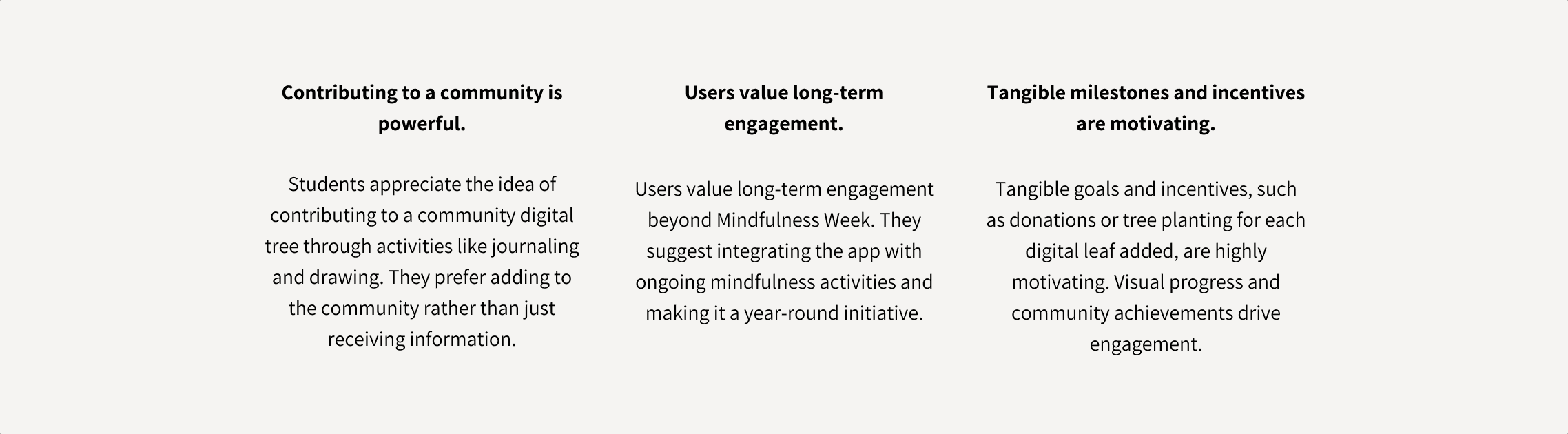
From our interviews, we gained the following 3 insights:

With a myriad of other mindfulness/meditation apps that exist in the market, my team differentiated Canopy by keeping the concept relatively narrow in scope, emphasizing simplicity and community.

Maintaining a central focus on the tree keeps Canopy simple while offering dynamic visualization.

Design

How can design facilitate intrinsic motivation?

How can design facilitate intrinsic motivation?

We went through several iterations of the mindfulness prompt, trying to design prompts that would motivate users to actually go through with the activity.

One of my biggest takeaways from this project was to trust the user. At first, we wanted users to write a response or upload proof of completion in order to obtain a new leaf. However, after extensive testing, we realized that doing so detracted from the experience. 

We went through several iterations of the mindfulness prompt, trying to design prompts that would motivate users to actually go through with the activity.

One of my biggest takeaways from this project was to trust the user. At first, we wanted users to write a response or upload proof of completion in order to obtain a new leaf. However, after extensive testing, we realized that doing so detracted from the experience. 

"People don't need points."

One user commented the above, emphasizing that gamification should not be the motivator. Rather, the app should facilitate their ability to do this for themselves, allowing intrinsic reward to be the biggest motivator.


Over several iterations of the prompt card, we decided on a simplified version that allowed the user’s internal motivation to take the lead.

One user commented the above, emphasizing that gamification should not be the motivator. Rather, the app should facilitate their ability to do this for themselves, allowing intrinsic reward to be the biggest motivator.


Over several iterations of the prompt card, we decided on a simplified version that allowed the user’s internal motivation to take the lead.

Adding other features with intentionality.

Adding other features with intentionality.

With a myriad of other mindfulness/meditation apps that exist in the market, my team differentiated Canopy by keeping the concept relatively narrow in scope, emphasizing simplicity and community.

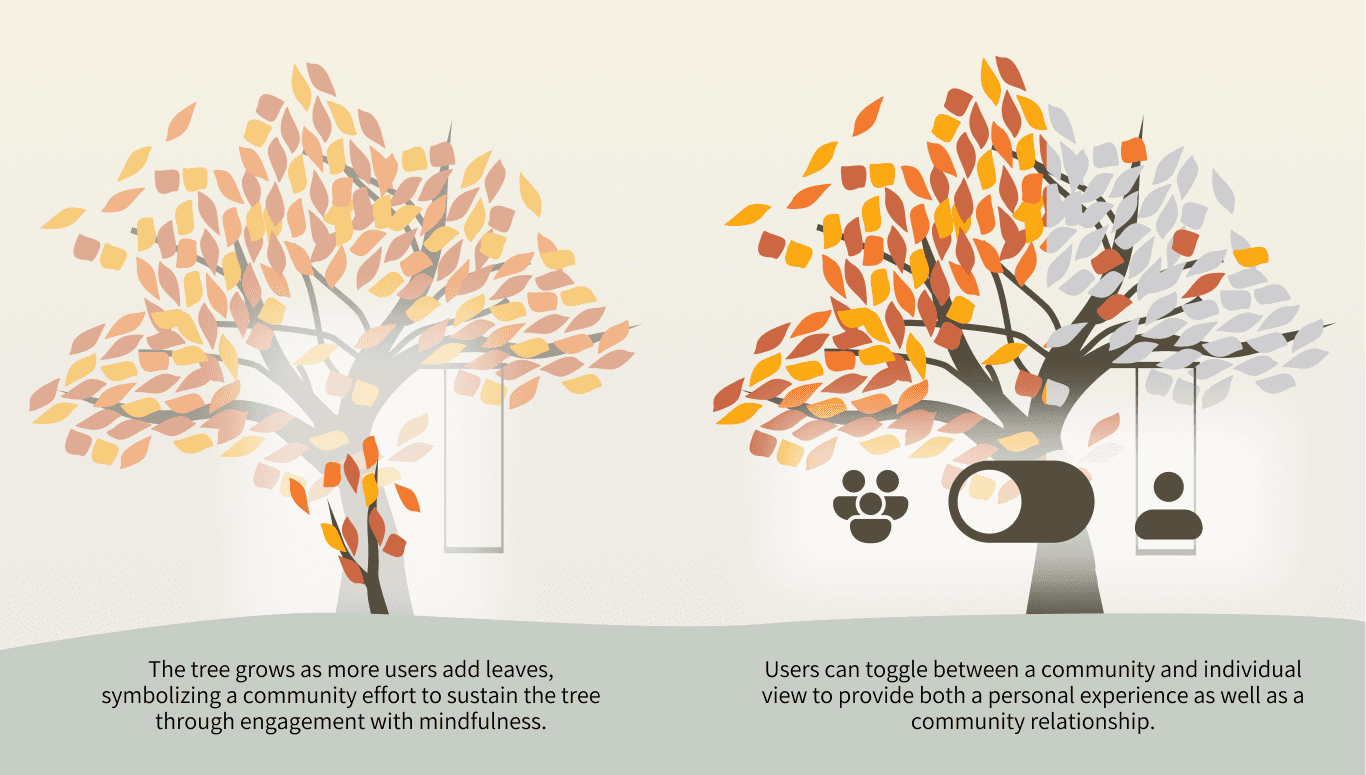
Maintaining a central focus on the tree keeps Canopy simple while offering dynamic visualization.
Details bring life to the Canopy tree and reflect real world community interactions with the arboretum.
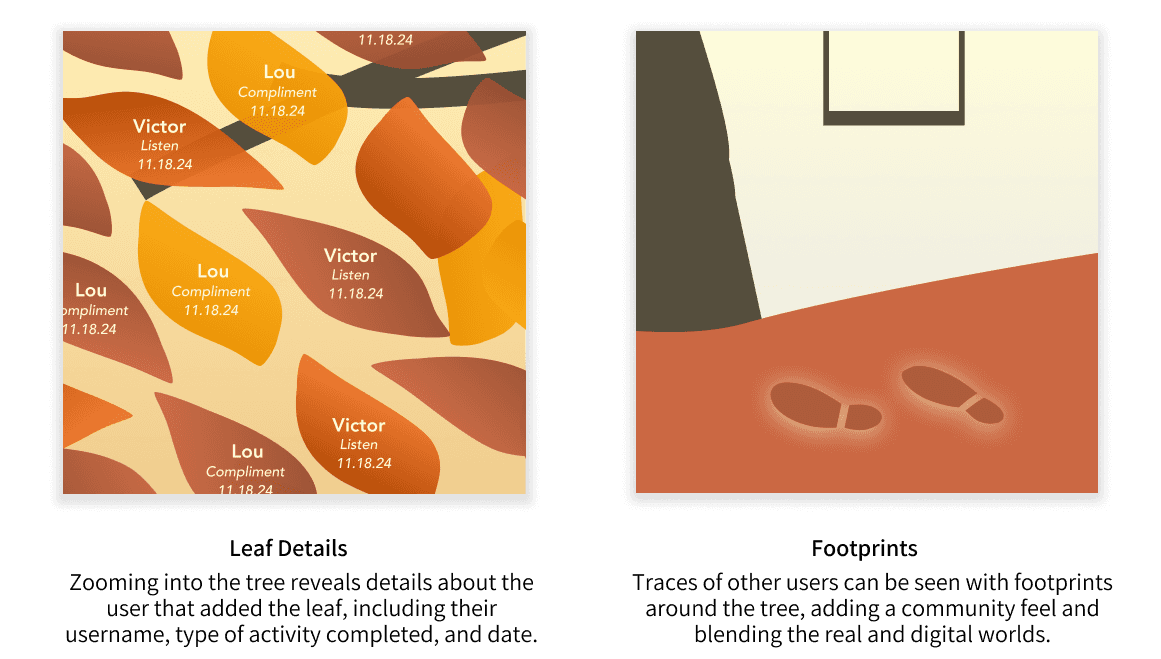
Details bring life to the Canopy tree and reflect real world community interactions with the arboretum.

In our final storyboard, we show the simple user flow from QR code to activity completion. The process is meant to be fast and limit time on the device itself.
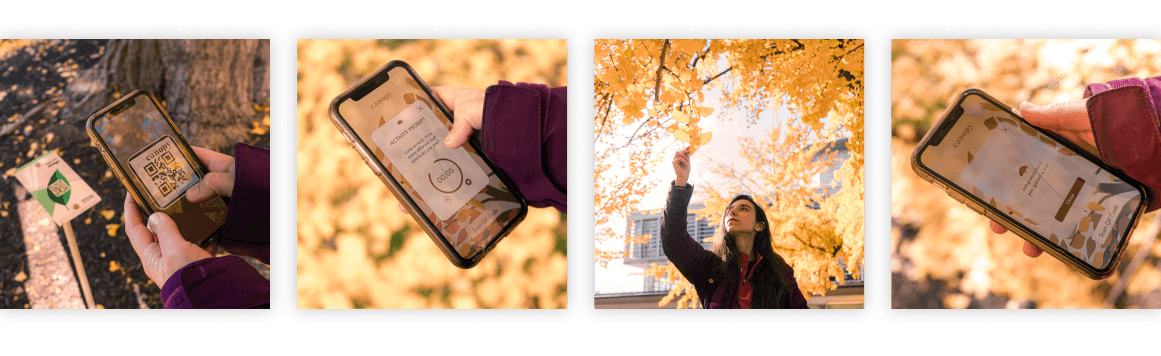
In our final storyboard, we show the simple user flow from QR code to activity completion. The process is meant to be fast and limit time on the device itself.

Reflection

Given more time, I would…

Given more time, I would…


  • Iterate more in lo-fi. For this project, the turnaround from research to a final prototype was quite fast. If I could work through the process again, I would love to take more time in the middle to iterate on lower fidelity designs unapologetically before getting locked in to one style. 


  • Test, test, test. I would take this project a step further by extensively testing the prototype. This would include 1) testing versions of a QR code to see what encourages people to scan it in the first place; 2) comparing reflection-based vs. activity-based prompts; and 3) understanding how users tend to navigate around the tree within the app.

  • Build in meaningful incentives. Many users we talked to mentioned that they would like to see a more tangible end goal (e.g., charitable donation every x number of leaves). With more time, I would love to build such a feature into the app and test its success.

  • Iterate more in lo-fi. For this project, the turnaround from research to a final prototype was quite fast. If I could work through the process again, I would love to take more time in the middle to iterate on lower fidelity designs unapologetically before getting locked in to one style. 


  • Test, test, test. I would take this project a step further by extensively testing the prototype. This would include 1) testing versions of a QR code to see what encourages people to scan it in the first place; 2) comparing reflection-based vs. activity-based prompts; and 3) understanding how users tend to navigate around the tree within the app.

  • Build in meaningful incentives. Many users we talked to mentioned that they would like to see a more tangible end goal (e.g., charitable donation every x number of leaves). With more time, I would love to build such a feature into the app and test its success.

Other Projects

Don’t be a stranger 🌱 Find me at wentingyu.dyw@gmail.com or linkedin.com/in/wentingy

Other Projects

Don’t be a stranger 🌱 Find me at wentingyu.dyw@gmail.com or linkedin.com/in/wentingy