IMIDeology
Building a mobile platform to support symptom tracking for autoimmune patients
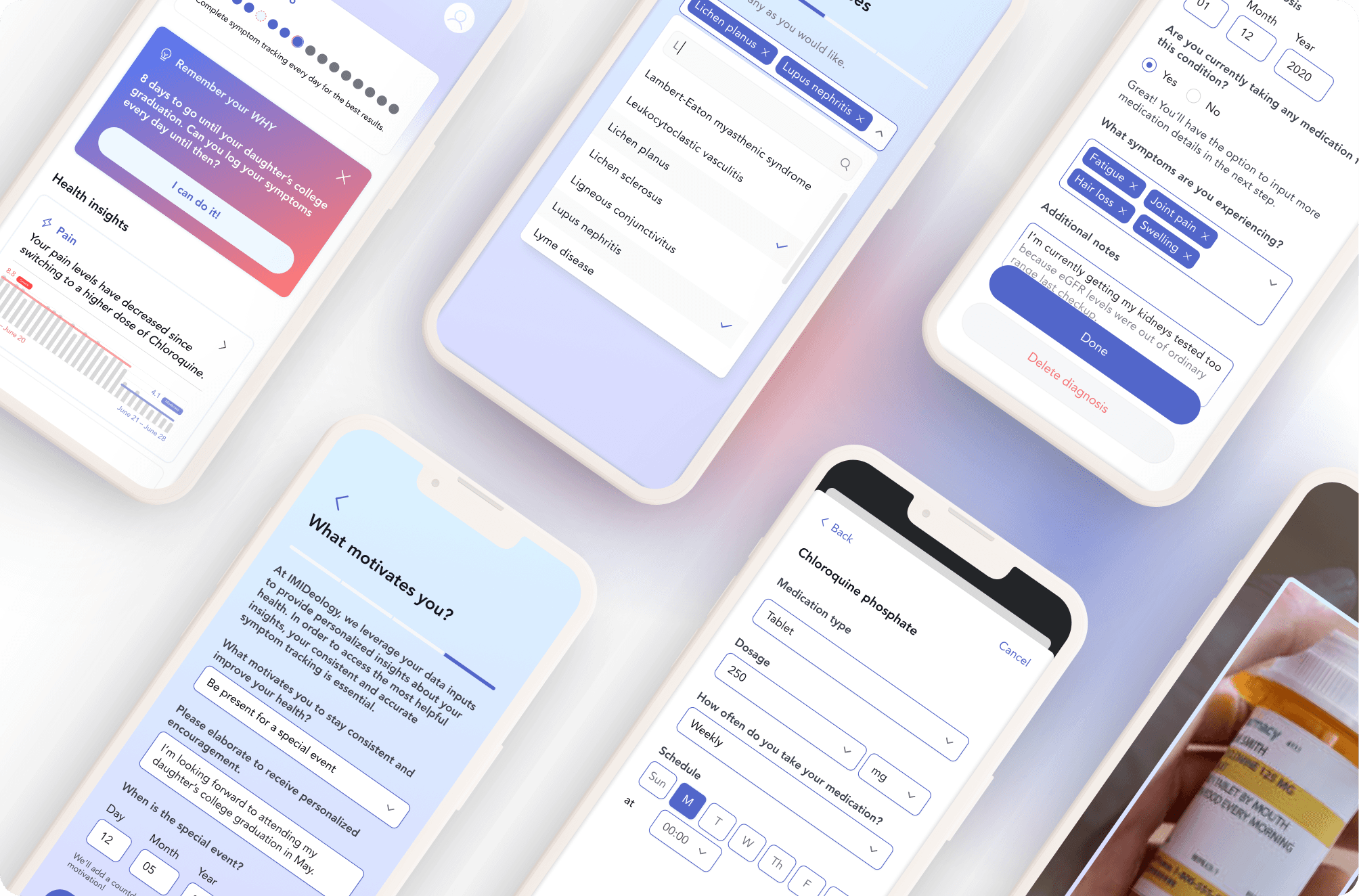
IMIDeology is a healthcare startup and virtual clinic dedicated to supporting patients living with autoimmune and inflammatory diseases (IMIDs). I joined IMIDeology as the lead product designer for an AI agent enabling patients to log daily symptoms, track medication adherence, and receive personalized insights.
Context
Sole product designer on an early-stage startup
Timeline
June - August, 2025
Team
Jin Lee, CEO
Jenny Liu, PM
Jimmy Chen, Research
Aaron Wang, Developer
Skills
Interface design, Iterative design systems, Product-thinking, User research
Defining the Problem
How might we help IMID patients consistently track symptoms in a way that feels valuable to them?
“Arthritis is a full-time job. And it’s not just the disease and the pain. It’s seeing doctors, keeping track of medications, and managing comorbidities.”
- IMID patient
Many IMID patients are juggling multiple symptoms, medications, and care providers. Asking them to log data daily risks feeling like an additional burden. Yet, this input is essential for personalized care. We needed to design a system that made this feel worthwhile.
Our goal was to bridge the gap between patient and clinician, allowing patients to gain clarity and control in their daily health and clinicians a more holistic understanding of their patient.
Design Process
Learning to strategically prioritize features in a lean startup environment.
With a target launch date of September 2025, we had less than three months to design and develop Version 0 of the web app. During our initial meetings, we aligned on our priorities for MVP, and what we would have to let go. Given the tight timeline, we decided to move forward with a hybrid web-based model rather than build out a full app.
MVP Model
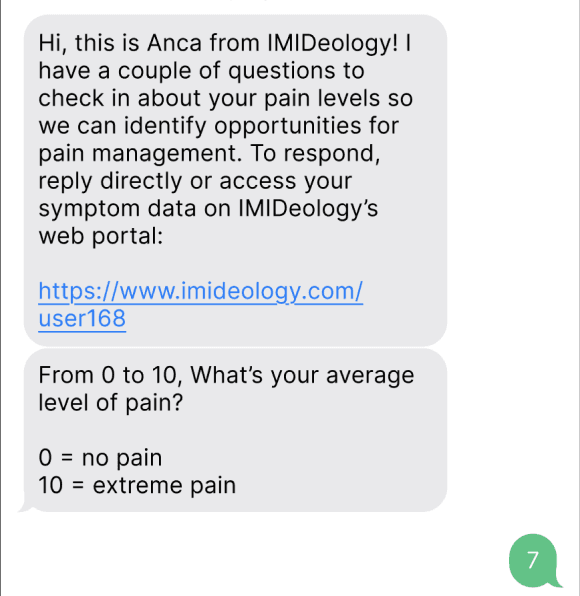
SMS-based data collection
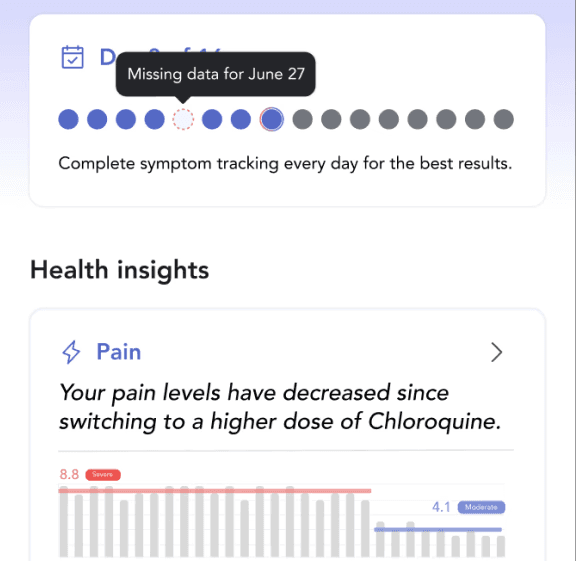
Mobile web dashboard
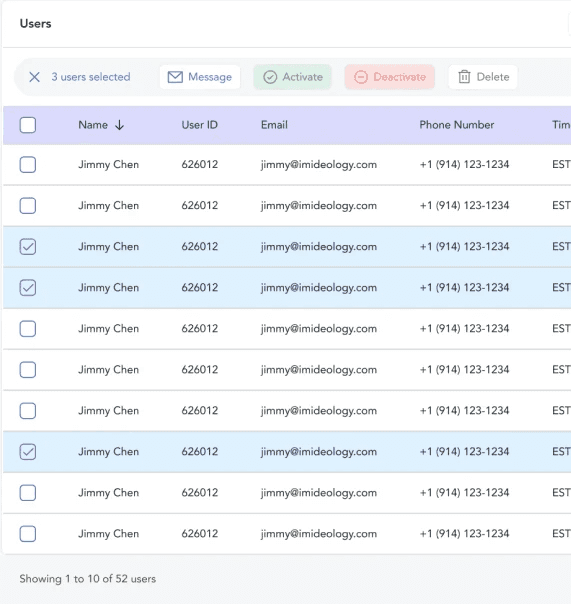
Client management system
User Research
Speaking with IMID patients helped me understand how our platform could support diverse and complex health conditions.

I conducted user testing with two IMID patients who were collaborating with IMIDeology. Because we were only able to reach users later in the design process, I used my mid-fidelity prototype for testing.
In each interview, I asked for user feedback regarding the registration process, their motivations, and presentation of symptom data. I walked away with a couple of takeaways for each of my two design goals.
Design goal 1: Creating a patient-driven registration experience
For people managing complex, ever-evolving health conditions, registration can’t be rigid or overly linear.
In my first design iteration, I had inadvertently created a rigid step-by-step process for documenting medical diagnoses. After initial user testing, I realized that the design to register diagnoses needed to accommodate diverse experiences.
I restructured the registration process to leave room for fluidity in the input of diagnoses.
Design goal 2: Demonstrating the value of data
My second design goal was to encourage symptom tracking past the registration stage. Raw data points that appear meaningless to users can discourage them from remaining consistent. Translating these data points into intelligible trends and personalized insights helps users feel like their data has value.
Personalized ‘mission statements’ can be used as an anchor for continued engagement.
Speaking with a diverse set of users reinforced a driving principle behind our design: health conditions and goals are deeply personal. Each user has a different motivation for improving their health; thus, engagement is strongest when tied to personal relevance and emotional context.
We designed an optional final step in registration: a prompt for users to describe why, in their own words, they want to track their symptoms and better understand their health.
Use raw data to surface patterns that users would not otherwise see.
My interviewees agreed that receiving feedback is crucial to understanding the value of their daily tracking. I designed secondary insight cards to display summaries of trends pulled from user data, but was not sure at first what level of detail would be most impactful in these insight cards.
Secondary insight cards | early iterations
These insights validate users’ tracking efforts and help them feel more connected to their own health story.
Visual Design Decisions
Building a cohesive, scalable, and iterative style guide for MVP.
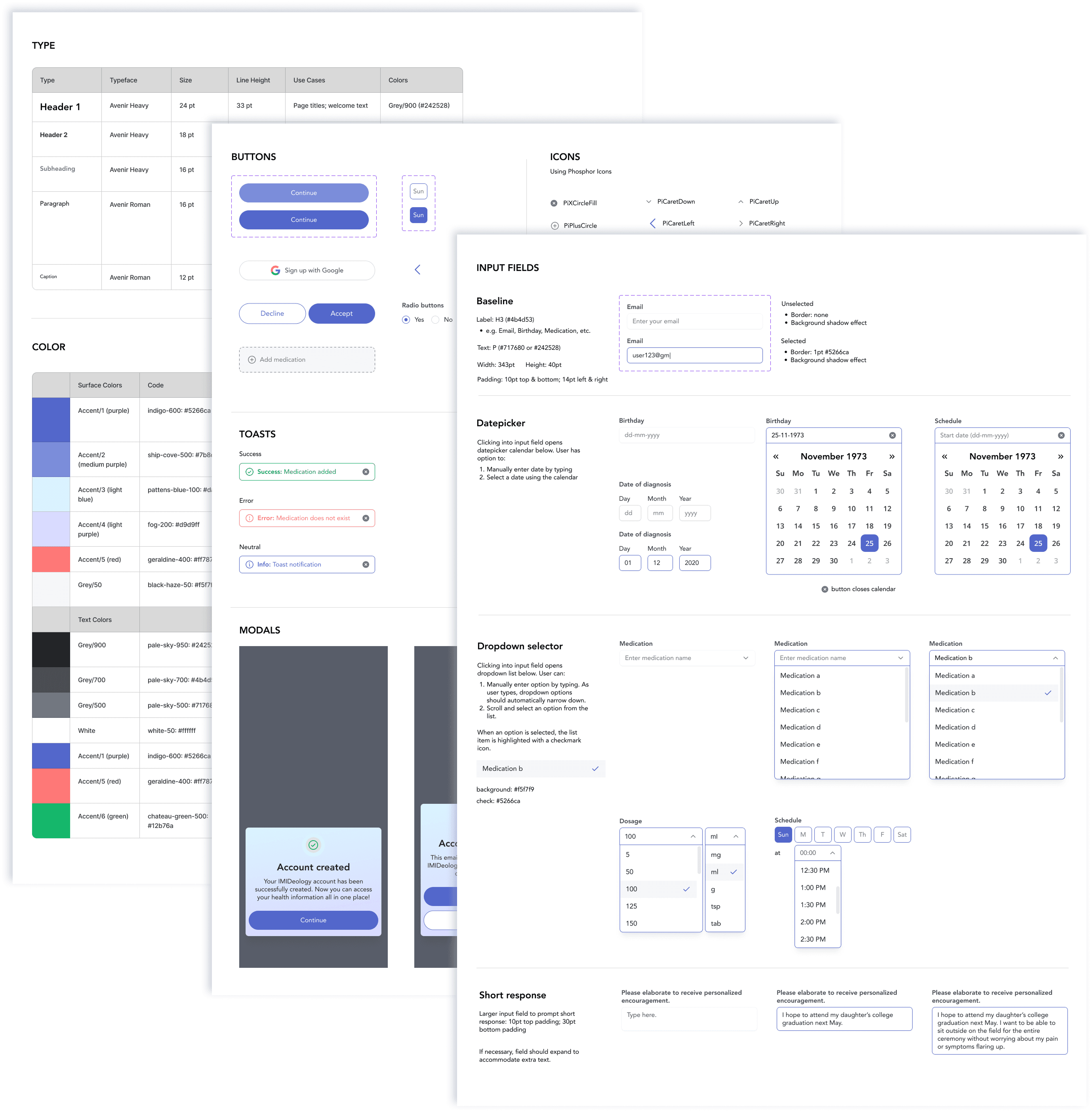
I worked closely with IMIDeology’s founder to ensure that the look and feel of the webpage aligned with her vision. We incorporated the soft purples, blues, and gradients already present in IMIDeology’s website, and used the Avenir typeface for a clean, lightweight read.
At handoff, I created style documentation to consolidate color, type, and component libraries, ensuring that my style guide was accessible to our developer and any future designers.
Team Collaboration
With a small, fully remote team, it was sometimes a challenge to coordinate meeting times. However, we maintained weekly meetings to brainstorm and give feedback. In addition, I set up alignment meetings with our developer to ensure my designs were clear and feasible.

Final Prototype
Reflection and Next Steps
If I were to go into the project again, here's what I would do differently:
[1] Concept test with users BEFORE committing to a direction. I felt like I started designing screens before we had clearly defined our goals for the project. Speaking with IMID patients and clinicians would have helped me better define the problem beforehand.
[2] Establish clear communication streams within the team. While we had standing weekly meetings, there were often points where I wanted to run a design by our developer. In the future, I would like to initiate checkpoints between design and development to better align ourselves.
What’s next?
IMIDeology launched the MVP of their web app in September at a patient health summit. In future versions, we hope to develop additional features.